

Translate this page:
You can translate the content of this page by selecting a language in the select box.
Share this link!
1 December - Archaeologists have discovered what seems to be remains of the world's earliest religious worship site in the remote Ngamiland region of Botswana. Here, our ancestors performed advanced rituals, worshipping the python some 70,000 years ago. The sensational discovery strengthens Africa's position as the cradle of modern man.
The new archaeological findings in Botswana show that our ancestors in Africa engaged in ritual practice 70,000 years ago - some 30,000 years earlier than the oldest findings in Europe, according to a report printed in the research magazine 'Apollon' published by the University of Oslo (Norway).
While, up until now, scholars have largely held that man's first rituals were carried out over 40,000 years ago in Europe, it now appears that they were wrong about both the time and place. Associate Professor Sheila Coulson, from the Oslo University, however claims to have proof that modern humans started performing advanced rituals in Africa 70,000 years ago. She discovered mankind's oldest known ritual in Botswana.
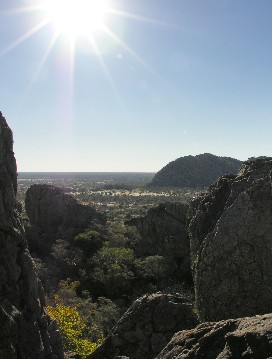
Ms Coulson made the discovery while searching for Middle Stone Age artefacts in the only hills present for hundreds of kilometres in any direction in Ngamiland, north-western Botswana. This group of small peaks within the Kalahari Desert is known as the Tsodilo Hills and is famous for having the largest concentration of rock paintings in the world, some being more than 1,500 years old. Tsodilo is listed as a Unesco World Heritage Site.
The Tsodilo Hills are still a sacred place for the local San people, who call them the "Mountains of the Gods" and the "Rock that Whispers". The San people - known as Basarwa or Bushmen in Botswana - are know to be Southern Africa's indigenous population. San guides who lead archaeologists to the Tsodilo Hills must first check with their deity to ascertain whether they are welcome there.
The python is still one of the San people's most important sacred animals. According to their creation myth, mankind descended from the python and the ancient, arid streambeds around the hills are said to have been created by the python as it circled the hills in its ceaseless search for water.
Ms Coulson's discovery shows that locals even thousands of years ago had a specific ritual location associated with the python. The ritual was held in a little cave on the northern side of the Tsodilo Hills. The cave itself is so secluded and access to it is so difficult that it was not even discovered by archaeologists until the 1990s. The first archaeologists at the site noticed two paintings on one side of the cave and a rock with a large number of indentations in it on the other side.
When Ms Coulson and her team entered the cave this summer, it struck them that the
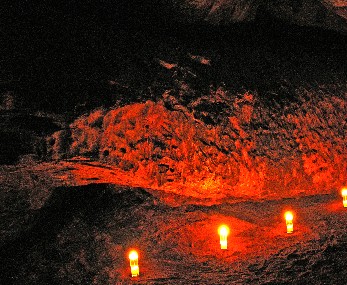
mysterious rock resembled the head of a huge python. On the six meter long by two meter tall rock, they found three-to-four hundred indentations that could only have been man-made.
"You could see the mouth and eyes of the snake. It looked like a real python. The play of sunlight over the indentations gave them the appearance of snake skin. At night, the firelight gave one the feeling that the snake was actually moving," Ms Coulson told 'Apollon'.
The team - composed of scientists and students from the Norwegian universities of Oslo and Tromsø and from the University of Botswana - found no evidence that work had recently been done on the rock. In fact, much of the rock's surface was extensively eroded.
Wondering what the cave had been used for and how long people had been going there, the archaeologist team decided to dig a test pit directly in front of the python stone. At the bottom of the pit, they found many stones that had been used to make the indentations. Together with these tools, some of which were more than 70,000 years old, they found a piece of the wall that had fallen off during the work.
In the course of their excavation, the Norwegian-Batswana team found more than 13,000 artefacts. "All of the objects were spearheads and articles that could be connected with ritual use, as well as tools used in carving the stone," the team concluded. They found nothing indicating another use of the cave.
Further, the stones that the spearheads were made from are not from the Tsodilo region but must have been brought from hundreds of kilometres away. These spearheads were better crafted and more colourful than other spearheads from the same time and area. Surprisingly enough, it was only the red spearheads that had been burned.
"Stone age people took these colourful spearheads, brought them to the cave, and finished carving them there. Only the red spearheads were burned. It was a ritual destruction of artefacts. There was no sign of normal habitation. No ordinary tools were found at the site. Our discovery means that humans were more organised and had the capacity for abstract thinking at a much earlier point in history than we have previously assumed. All of the indications suggest that Tsodilo has been known to mankind for almost 100,000 years as a very special place in the pre-historic landscape," according to Ms Coulson.