
Translate this page:
You can translate the content of this page by selecting a language in the select box.
Share this link!
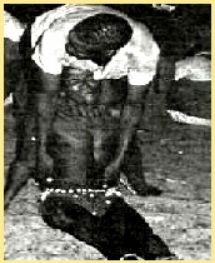
San Healer in !kia treating a patient.
Different cultures throughout the world have dealt with the spiritual aspects of life in different ways over time. Some have separated and partitioned off aspects of the spiritual side of humanity into focused categories, such as medicine, religion, and community gatherings. Many people in Western cultures, for example, go to the doctor when they are sick,to a place of worship when they are seeking spiritual reflection, insight, and reconciliation, and to some sort of group gathering (sometimes in a place of worship) when they are looking for a sense of community.
Often times these categories are linked together and are interrelated, such as when an individual in a place of worship asks the congregation to pray together as a community for someone who is sick. Just as often, however, and it seems to be increasingly so in our busy, modern times, these categories are kept separate, and any interrelation between them is not officially recognized. Medical problems are simply a case of the machinery of the human body breaking down, while anyone who has time to hang out with a group of people in a community setting has 'too much time on their hands'. While this may be the trend in many developed Western cultures, it is the polar opposite of the !Kung culture.
For the !Kung, there are no divisions in any aspect of life, because everything is life, and everything is interconnected. This figures prominentlyin the ceremony that acts as both the !Kung's most visible display of personal and communal spirituality, and as their primary method of healing sickness, injury, and disease: the healing dance. Richard Katz, another member of the Harvard Kalahari Research Group, who has done the vast majority of the research on the healing dance, and on what it means to both the !Kung and to others, has perhaps summed up the significance of the dance the best.
"The dance provides the focal point for what anthropologists consider to be the central features of a culture. The dance is the !Kung's primary expression of 'religion', 'medicine', and 'cosmology'. It is their primary ritual. For the !Kung, the dance is, quite simply, an orienting and integrating event of unique importance." (Katz 1982:36).
The Spirits of the Dead
The healing dance is, in it's physical form, just that, a group dance whose aim is to provide healing to those who are suffering, both physically and spiritually. To begin to understand the dance, and it's significance, one must first understand how a person becomes ill or injured in !Kung society. The !Kung believe one of the primary sources of illness and mishap in the world is the gauwasi, (also called gangwasi by Lee (1984:106)), or the "spirits of the dead"(Katz 1982:29). These are the spirits of ancestors who now live in the sky with God, and who sometimes come down and wreak havoc, causing accidents or illnesses.
There is a some disagreement among the !Kung as to why this occurs, but it seems as though the consensus is that while some are mischievous, and some are not, most gauwasi are simply lonely. While they have everything they need in the sky, they don't have the love of their relatives on earth. So, sometimes, they come down and make a person ill in order to get them up to the sky. All in all, the issue of health and healing among the !Kung is, at its heart, a battle between the living, who wish to keep the sick person with them, and the spirits of the dead, who wish to take the individual with them(Katz 1982:43; Lee 1984:107-109). Thus, it goes far beyond the simple physical aliment that might plague someone. For the !Kung, the spiritual world and the physical world are one, and there is no separating what occurs in them.
The Dance
The traditional healing dance itself, known as the Giraffe Dance, is usually an all-night dance that incorporates every member of the community who wishes to participate. They take place once every two weeks or so, and are a regular event looked forward to by the members of the
community as a chance to be together, singing, dancing, and healing (Katz 1982:34-36,49). The dance usually consists of dancers, some of whom are healers, who dance around singers who are singing and clapping around a fire. The dancers are predominately male, and the singers female, however, a number of women are powerful dancers and healers.
The night begins in a lighthearted and fun way, and at some point begins to turn more serious(Katz 1982:40). As the night goes on,the dancing becomes more and more intense, as does the singing and clapping,and the healers in the group begin to activate /um, or a "spiritual energy", from within themselves. The activated n/um spreads throughout them and the group, and, for some, leads to !kia, or "experiencing an enhancement of consciousness" (Katz 1982:34).
It is in this state, the !kia state, that healers are able to heal people, using the power of the n/um that they have activated inside themselves. The influence of !kia is extremely powerful, and usually
only a few healers at a time achieve it completely. This is not to say that every !Kung is not allowed to try to achieve !kia. In fact, everyone is encouraged to try to learn to heal, and over half the men, and ten percent of the women usually become healers(Katz 1982:35).
There are a number of reasons why even more people do not heal, including possible genetic connections to !kia experiences, as well as fear of the pain associated with learning to activate n/um and achieve !kia (Katz, in Lee 1976:289). An understanding of the pain involved in achieving !kia offers a bit of insight into the perspective of the person who is trying to achieve it.
N/um, !kia, and Healing
The !Kung describe n/um as something which resides in one's stomach, and is heated and begins to boil during dancing. There are many descriptions of how the n/um travels up the spine and rests at the base of the skull, during which time the healer begins to shake under the influence of it (Katz,in Lee 1976:286-287). If all goes well, the healer will soon experience !kia. Unfortunately, the hot n/um is very painful in the stomach at first, and the experience of !kia, which is so powerful as to be considered dangerous, can be overwhelming to a newcomer.
Various healers describe the experience of !kia as a "bursting open, like a ripe pod" as the n/um explodes in the brain (Katz 1982:44). The experience of !kia is compared repeatedly by the !Kung to dying and being reborn. As a result, there is a real fear of death associated with trying to achieve !kia, a fear that only the dying part will take place, and not the rebirth. If the rebirth does occur though, it puts the healer in a state where he or she is then able to go and heal, by putting n/um into others, as well as pulling sickness out(Katz 1982:45-46).
The healing that occurs is quite real, as those in !kia struggle with the //gauwasi over an ill person. The battles waged on the physical/spiritual plane are intense ones, with healer's souls often leaving their bodies to plead with the gods and the spirits for the soul of the sick. If the healer is vigorous enough, and if his n/um is powerful enough, the illness will leave the person (Katz 1982:43).
Having a seriously ill person is not the only reason to have a dance, though, for regular dances provide a myriad of other benefits to both individuals and the community. Even if no one is gravely afflicted, the healers will make a point to heal everyone, every time. This stems from the !Kung's perception of what "sickness", "healing", "illness", and "curing" mean.
The !Kung believe that everyone has 'sickness' in them all the time, and, sometimes, often with the help of the //gauwasi, this sickness is made visible as an illness. Similar to kinetic energy, the "potential for illness" is always there (Katz 1982:53). Healing is used to both 'cure' a particular 'illness', and to prevent 'sickness' from become an aliment. Thus, regular healing, in which healers draw sickness out of people with the help of n/um and cast it away, is a !Kung version of "preventative" medicine (Katz 1982:53).
The Dance and the Community
As mentioned earlier, the healing dance means much more to the !Kung then simply being a place for individuals to be cured of illnesses. It is a holistic event that acts as the central expression of the !Kung culture. Thus, it serves a myriad of purposes, all interrelated and, in the eyes of the !Kung, inseparable. One could argue that the community gains more from each dance than any one individual does, for each dance is a cathartic release of energy and tension, and provides people with the chance to be together in an intimate setting different from the one they usually live in.
Healing is given for free, and is a gift to be shared with the entire group. In recent times, some healers have begun to charge non-!Kung for healing services, and this has caused a great deal of debate and disagreement among the !Kung as to the nature of healing (Katz 1982:177-195). Even so, most agree that the dance exists so that they can heal, on a myriad of levels, from the physical to the spiritual, each other, the community, and their world.
====
Credits
This explanation of the !Kung healing dance is only a brief outline, and cannot do justice to what is a regular and heartening event in a community that is truly inspiring. For a much better picture of the dance (as well as for a much better telling of the story), please see Boiling Energy, by Richard Katz. The specific publishing information is listed in the Bibliography. The book is a wonderful piece of work for anyone interested in topics related to holistic healing, community renewal, and spiritual transcendence. More importantly,it offers an intimate and clearly drawn picture of the !Kung as a people, one that conveys a deep appreciation for who they are.
Comments to Catherine Lephoto and Jacob Yarnell at Lawrence University, Appleton, Wisconsin.
Revised December 16th, 1996