Translate this page:
You can translate the content of this page by selecting a language in the select box.
Alabama Pushed A Black Family Off Its Land- And Left It Empty For Years
By TODD LEWAN
AP National Writer
SWEET WATER, Ala. (AP) _ The legacy Lemon Williams always hoped to leave to his grandchildren was the land of his birth.
His 40-acre cotton-and-bean farm was among the smallest in Marengo County, but the land his grandfather had settled after the Civil War meant everything to Williams.
''This land,'' Williams always told his son, Willie, ''is part of our family. Treat it like your brother.''
Then, in June 1964, a letter arrived. The State Lands Division had checked the title of the property with the Bureau of Land Management. The federal agency had replied that, as far as it could determine, the 40 acres belonged to the state.
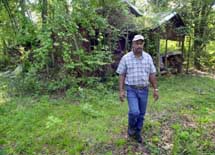
Willie Williams near his family's former land
AP/Dave Martin [16K]
How could this be if, as the family's original deed said, Williams' grandfather had bought the land for $480 on Jan. 3, 1874?
In 1906, the letter said, the federal government had designated the 40 acres as swampland and patented the property to the state of Alabama. The 40-acre farm of Lawrence Hudson, Williams' cousin, also belonged to the state for the same reason, according to the letter. The attorney general, the letter said, was now suing both families for their land.
The families gathered their children and their deeds and took them to J.C. Camp, a lawyer in Linden, the county seat. The lawyer and both couples have since died, but Lemon Williams' son and daughter, Willie and Inez, say they recall every detail of the meeting.
''Camp took our money, took our deeds, put them in his drawer and promised he'd fix everything,'' said Willie Williams, 50. ''We never saw those deeds again.''
In 1965, a fire ravaged the Marengo County courthouse. Many records survived; the file containing the Williams and Hudson court case apparently did not. The Associated Press found only the trial docket.
The State Lands Division in Montgomery, however, monitored the case. Letters and internal memos from those files are peppered with references to the Williams and Hudson families' race. They show officials adamantly opposed to allowing ''the negro defendants'' to keep the land, even though they acknowledged in writing that both families could trace their ownership back to 1874.
In an April 30, 1964, memo, George T. Driver, a former state lands director, wrote: ''The lands are being claimed by Lemon Williams ... (a colored man).'' A Nov. 30, 1964, memo by William G. O'Rear, chief attorney for the state conservation department, refers to ''the negro defendants.'' And in 1966, Marengo's tax assessor noted: ''Land Bk shows above 40 acres still owned by L.B. Hudson (black).''
A year later, Circuit Judge Emmett F. Hildreth asked the state to reconsider the lawsuit. Taking the land, he wrote, ''would create a severe injustice.''
Claude D. Kelley, then Alabama's director of conservation, replied that the state had no intention of dropping the lawsuit because income from cutting timber on it could be used for state-run hospitals.
In 1967, Hildreth ruled that Williams, Hudson and their wives could remain on the land but could not farm or log it. When they died, his decree said, the state would take possession.
Hudson died in 1975 and his wife died shortly afterward, but family members say the state waited until last year to ask their children to leave the farm. They moved to nearby Butler.
The Williamses moved to an acre lot several miles from their old farm after Hildreth's ruling. For three decades, they pleaded for the land in letters to state officials and received form letters in response.
The vine-wrapped house that was once the center of their farm is slowly collapsing. Conservation officials have opened some of the area to timber cutters, state records show.
James Griggs, director of state lands, said the dispute was handled properly. ''There have only been two owners of the land, the federal government and the state,'' he said.
The Associated Press, however, found deeds on file in the county courthouse documenting the Hudson and Williams families' ownership of the property all the way back to 1874. There are also surviving records showing both families paying taxes on the land from the late 1950s until the land was taken.
After being told of the AP's findings, Alabama Gov. Don Siegelman read the files and said he found them ''disturbing.'' He has asked the attorney general to review the case.
EDITOR'S NOTE - Associated Press Writer Bill Poovey contributed to this report.
© 2006 Associated Press