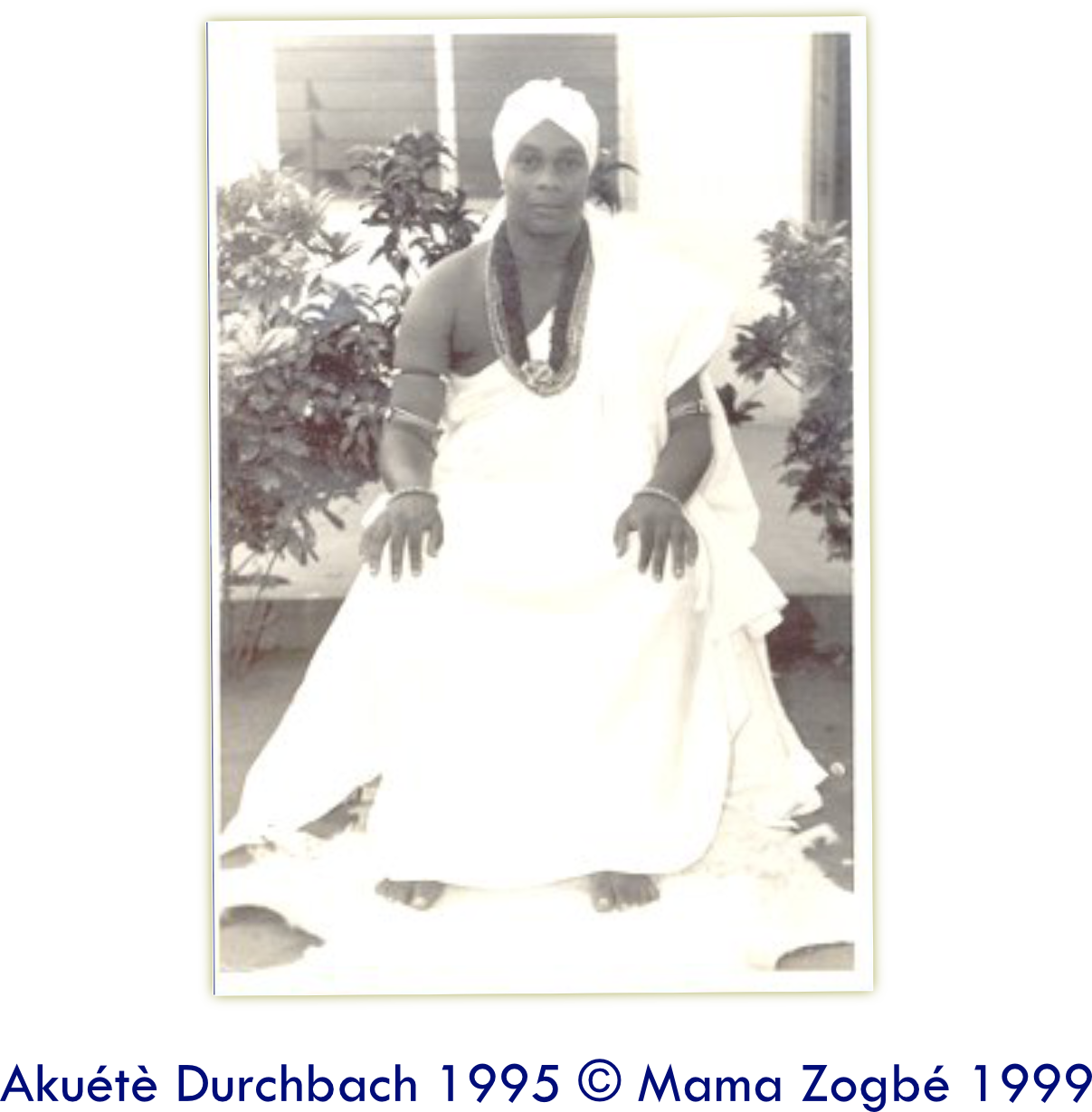
Durchbach Akuétè is a 38-year old spiritual master and traditional healer from Lome, Togo, West Africa. His knowledge of herbs, trances, divining, psychotherapy, and paranormal healing are profound. He is also a rare master who understands the Western mind and who can cross over cultural barriers, deftly explaining his spiritual practices for the Western seeker. This summer, Durchbach Akuétè will be visiting the U.S. for the first time, presenting to various groups including the Association for Humanistic Psychology, the Association for Transpersonal Psychology, and the International Conference of Shamanism.
Togo, a West African country, is rich in ancient traditions. When I first went there five years ago, I roamed the capital city, Lome, in search of traditional healers. After several days I met an African woman whose brother-in-law was a renowned voodoo priest. For two days, I visited at her home, playing with fourteen children and building a bond of trust. I asked and answered many questions until the family felt it was safe enough to introduce me to Akuétè, the voodoo priest.
Our first meeting was arranged for ten o'clock at night. It was a thick, humid night when I entered a large gate into a sand courtyard. Inside was a compound of buildings. The largest house was directly ahead opposite the gate. People were lounging on the concrete patio and one man, dressed completely in white, sat at a table eating dinner. A doll, twelve inches tall, was next to his plate. Clearly, this was an honored spiritual symbol. The woman accompanying me approached respectfully and waited for Akuétè acknowledgment. We sat and a bowl of water was passed among us, each of us sipping a little and spilling a few drops on the ground: a little sustenance for us and some for the spirits.
Press 3 lines above to open MENU

Translate this page:
You can translate the content of this page by selecting a language in the select box.
Share this link!
E C S T A T I C S P I R I T S
A West African Healer at Work
Note from the Mami Wata Healers Society Temple of Mawu:
To preserve the integrity of the article, we have allowed the following statements and photos of the original article by Mama Zogbé to be kept in their original tense. We have placed two archived photos to the right of her writings at the start of the article.
We give thanks for the many sacrifices our founders, Hounon-Amengansie Mama Zogbé and Papa Mou Mou Akuétè Durchbach individually and collectively made to protect, guide, unearth and illuminate the traditions of our ancestors. By doing this, they gave us all a great gift, an amazing chance,
an exceptional opportunity.
They will never be forgotten.
Akpeloo!
Note from Mama Zogbé:
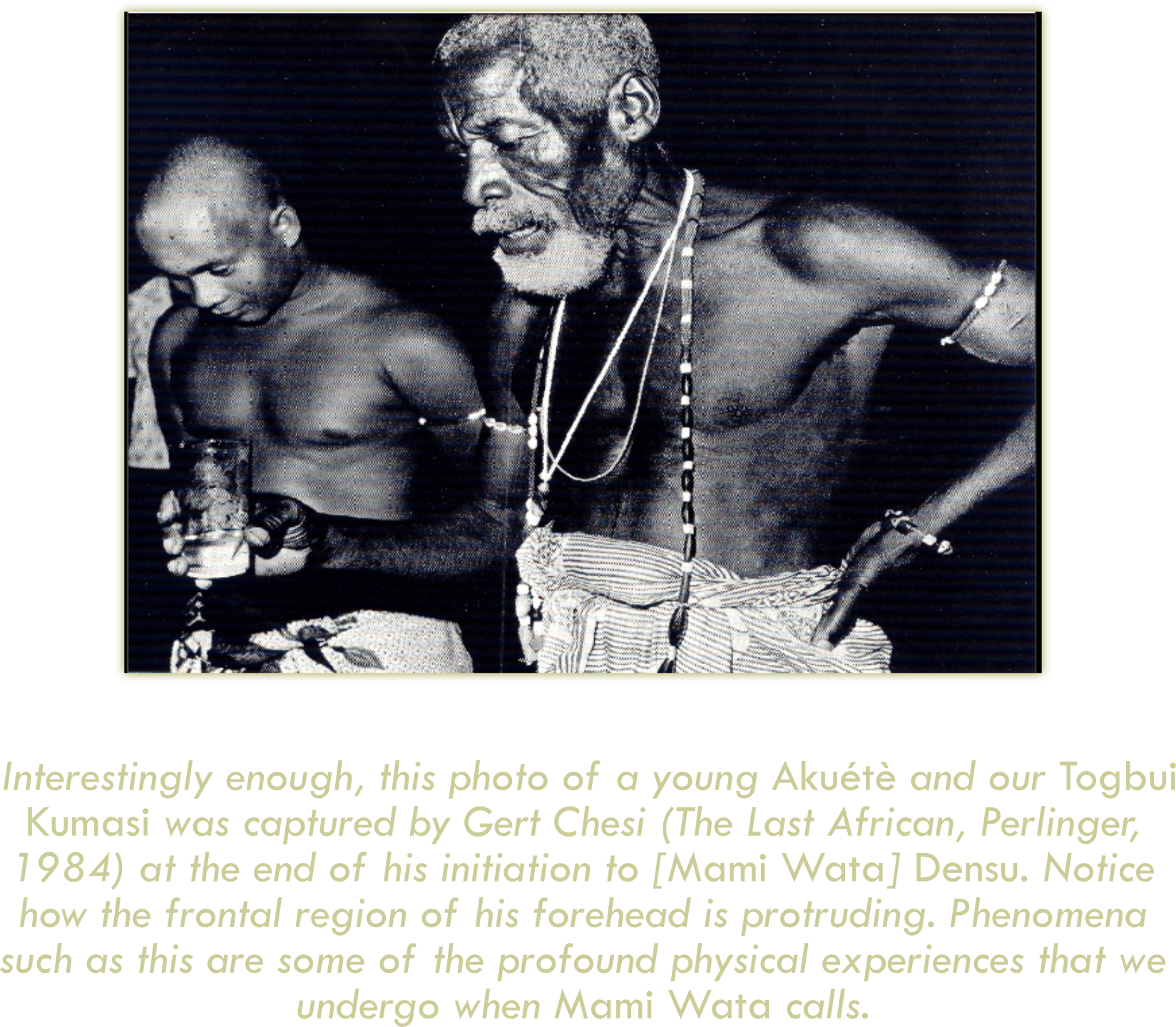
Akuétè Durchbach was a master Priest of both the Yeveh Vodoun and the ancient Mami Wata tradition in Togo, West Africa. At the time that Danny wrote this article, very little was known in the West about Mami Wata. As a result, Akuétè is referred to as a "Voodoo" priest. Akuétè Durchbach was a Master Shaman who studied for 6 years in the sacred Be (bay) Forest with the aboriginal shamans in Togo. He was crowned Densu, a 300 year old Mami Wata spirit, inherited from his father via his great ancestors. He was Hounon of the Vodoun being born with all the major Vodoun. He was also a medical doctor, being pulled out of his training by Mami Wata early in his internship. He was respected and feared by many. His power, compassion and knowledge was phenomenal. He helped many people in both Europe and America, as well as his own village. Masters such as Akuétè are rare today even in Africa. I have been blessed to have had him physically in my life as both a godparent, teacher and friend for nearly 10 years, and now in spirit as my helper and guide. This article is a rare look into the life of a Master of our ancient African traditions.

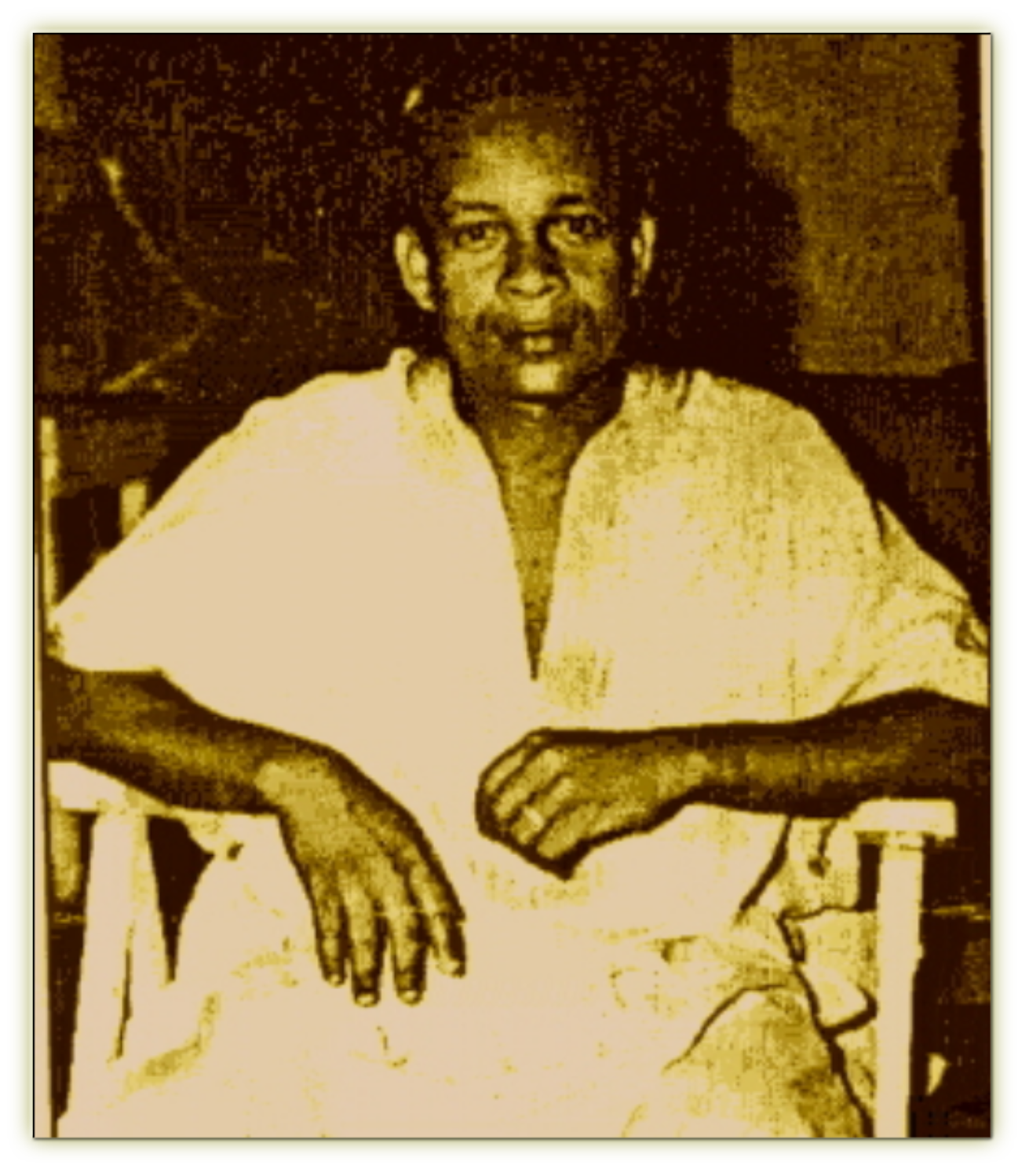
Papa Mou Mou Akuétè Durchbach healing at a conference in 1987. This conference is where Papa Mou Mou Akuétè Durchbach and Chief Hounon Amengansie Mama Zogbé met.

(L-R) Papa Mou Mou Akuétè Durchbach and the late Hounon-Amengansie Mama Zogbé, leading founders of the Organization of Traditional African Healers (OATH). After the transition of Papa Mou Mou, Mama Zogbé would later go on to found The Mami Wata Healers Society Temple of Mawu with Chief Hounon Amengansie Mama Zodédé.
Akuétè and I began our meeting. I had no idea what Voodoo really meant. Running through my mind were pictures from horror movies and stereotyped images, pins and dolls from witchcraft novels.
Yet, in contrast, Akuétè was not a man vehemence of fire, or lust for power. He was a gentle, curious, educated, and open man. For hours that first night, we shared ideas, stories and traditions. Over the years our friendship has grown, and we are now important to each other's families.
Akuétè is a fascinating man with a remarkable history. As a small child, he demonstrated paranormal powers and often behaved as though he was possessed by forces and spirits. His family recounts tales of his staying under water for more than ten minutes and being engulfed by flames in a fire while neither his clothes nor his flesh were burned. For hours he would remain in trance.
His family, who adhere strictly to Christianity, were deeply concerned by his behavior and did not encourage this direction, nor did he. To their relief, he was able to repress his traditional spiritual path and focus his attention on school, where he excelled. Eventually, he was sent to Paris to study medicine.
After several years of studying, he was once again overcome by his ancestral spirits. He recounts feeling confusion and resistance to his destiny as a spiritual teacher. On one occasion, there was a knock at his door and the great serpent spirit of Africa entered. He was thrown to the bed and the serpent enveloped him, ending up as a crown on his head. With the spirits reawakened and dramatically disrupting his life, Akuétè was no longer able to resist his destiny. He left Europe and returned to Lome. During the next two years, he changed his life and established himself as a Voodoo priest.
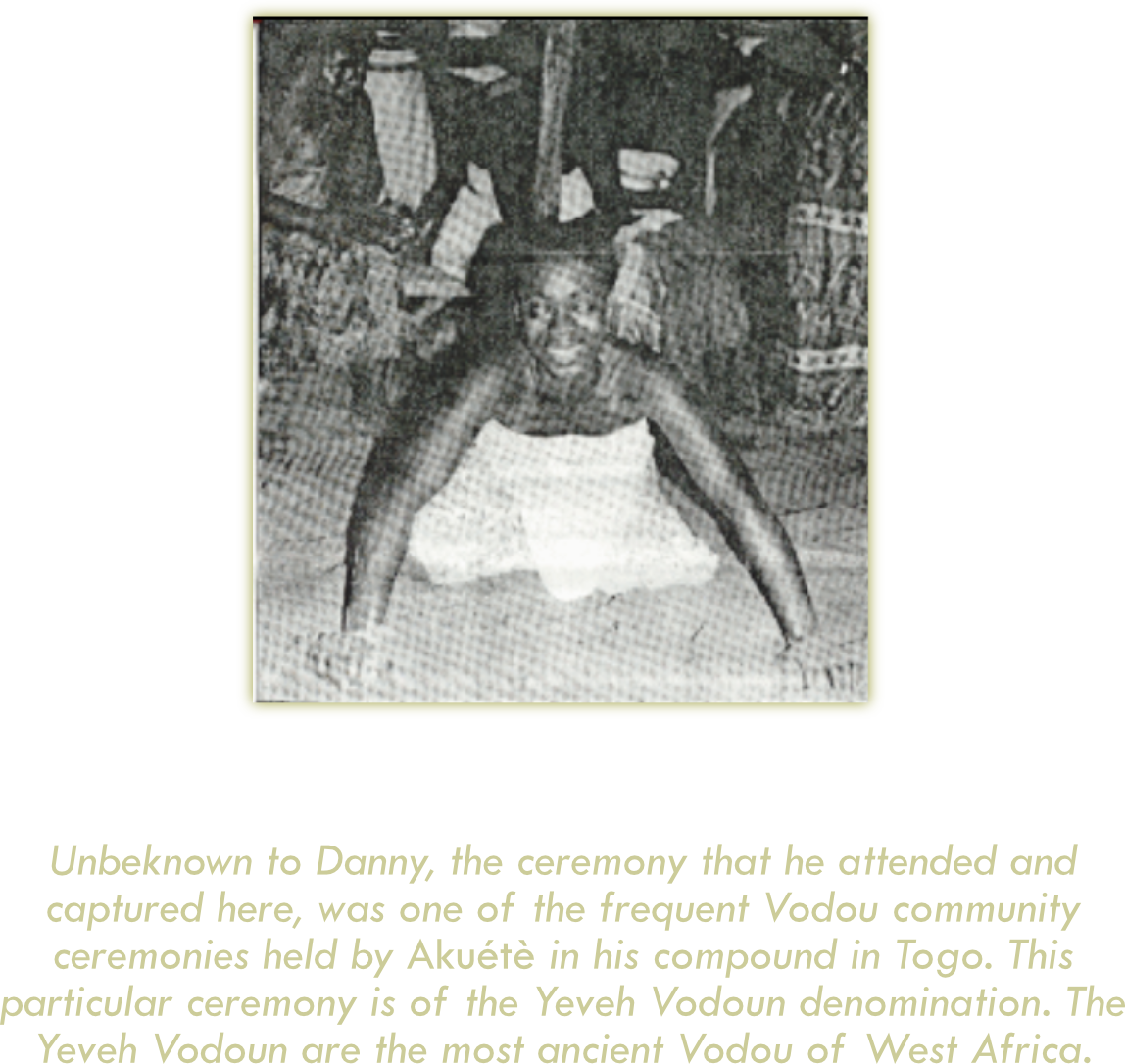
Voodoo is a marvelous, complex religion. Its structure resembles Hinduism, with many spirits and gods. Ceremonies include elements underscoring a sacred relationship to the Earth. The main avenue of spiritual practice is entering a trance state in which one experiences the spirits directly. The phenomenon is observed in traditional societies around the globe. Even though the goal of trance states is similar, the content of the ceremony distinguishes the culture.
A Voodoo ceremony in West Africa is spiritual ritual in which congregants enter an altered state of consciousness through dancing and chanting. The West African priest welcomes the spirits to the ceremony. He prays that they will bless members of the group, enter them and perform wondrous transformations, revelations, and healings. The trance is thought of not as a state of availability to the spirits, but as the spirit form entering the human form.
The belief that Spirits and Gods directly intervene in a person's life is very different from the Western world view. Unlike the Christian who goes to a priest to confess or pray to Jesus, or the Jew who prays directly to an abstract god, the African actually becomes his God. There is no separation whatsoever.
Whether we are talking about a culture using masks and costumes, or one like Voodoo without these elements, Africans grow up knowing they can become their Gods. This is a radically
different point of view about who one is and what the course of life might be.
Ceremonies are regular weekly and biweekly events. While they have a starting time, they end when they end. Unlike Judeo-Christian services, there is no book to follow. Songs amid drumming call forth different spirits. Depending on the nature of the group, and the priests and their relationship to the Spirits, the ceremony can last three hours or three days. When the spirit work has been completed and the Spirits depart, the ceremony ends.
The ritual begins with drumming. While most spirit forms remain unseen in a sacred shrine, one spirit whose form Akuétè can reveal is unveiled to the group. It's a three foot statue of an African boy, dressed in Western clothes. The ceremony area is prepared with perfumes, water with rose petals, and white powder. A member of the congregation walks around the area sprinkling powder and scents. The white powder purifies and attracts spirits. The Gods enjoy the sweet smells and are more willing to come to the ceremony and help the congregants. The drumming continues, and at a certain moment Akuétè joins the group after preparing himself in his sacred shine. He dresses in his traditional ceremonial robe. He leads the singing and chanting, directing the members to be more excited and evoking if they are to gain the spirits attention.
The songs for the Gods and the rhythmic drumming and clanging of African bells raises the tempo. A few people break out into dancing, in groups of two, three, and four. Men and women walk across the center of the gathering waving their elbows as though they had the wings of fowl. They create a type of line dance reminiscent of "the stroll" which came out of Philadelphia in the sixties. One woman falls to her knees, her body moving in fits, shakes, and jerks. She has entered a trance, at one with her gods. Her eyes glass over and an ecstatic smile covers her face.
Another congregant's eyes roll up into the sockets and her gait changes to an aimless wandering. She slaps the hand of a man seated in front of her as though she were saying hello - in our black culture "giving five." Then she continues around the group, slapping everyone's hand. When she arrives at Akuétè, she shakes his hand and talks. It is not a normal conversational tone, rather a stilted, shouted sound. Obviously, these weren't greetings from the woman, but the spirit speaking through her. In trance, people don't speak their language as in normal conversation; rather, it's formal and stiff, similar to Shakespearean English in contrast to American slang. People in trance have a frozen glaze on their faces, their personalities have been displaced and access to regular conversation and eye contact is no longer possible.
I have a striking slide of an older woman on her knees, pouring powder all over herself. She's nearly covered, and as she pours it on thicker and thicker, she wails what seem like non-verbal sounds and rocks spasmodically. At one point in her trance, she rose and began pouring white powder on everyone, laughing and swooning as she circled the congregation.
During another ceremony, when my group was finally relaxed, singing and dancing with the Africans, I said to myself, "Everyone looks fine. I think I'll take a moment to feel if the Gods have any message for me." As I said this sentence, a woman deeply in trance came up to me and knocked me in the forehead with her forehead. It was such a startling response to my inquiry that I said aloud, "I guess the Gods are paying attention."
When I take groups of Westerners to experience this marvelous religious rite, I'm usually a little concerned for their comfort. I know they'll see things beyond their reality that may leave them feeling uncomfortable and unsafe. I remember at my first ceremony exclaiming to myself how we have so many inaccurate stereotypes of Voodoo as Satan worship or witchcraft. Yet here is a beautiful, complex religion in which people are trying to know their Gods and feel the ecstasy which spiritual oneness brings.
The congregants are full of caring and concern for one another arid their guests. When people are in a trance, the group looks after them, ensuring that they do not hurt themselves, they are comfortable, and their clothes do not fall off causing embarrassment. I have never witnessed elsewhere the degree of common support and kindness that I experienced among the Voodooists.
On one of our visits, we were meeting with Akuétè the day following a Voodoo ceremony. A wonderful, warm and open woman in the group was sobbing deeply. Akuétè asked what was the matter, so I asked her and then translated. She had lived so many years without a vital sense of her spirituality, and now she felt how much of life she had missed. That realization had filled her with deep sadness.
I explained this to Akuétè, and without her nor other members of the group knowing, he called on one of his spirit guides and sent it to heal this woman. This spirit is invoked and then sent by blowing across one of his fingers. I've seen him do this on several occasions and it looks to the uninitiated as though he just has his hands together in a prayer fashion. He explains that his arrangement with the Spirits is that they come and teach him.
Once a bond is formed and the power is part of Akuétè, he can call the spirit to do certain tasks and they work together. Although it sounds as though Akuétè himself is not doing much work, he is. When he does not invoke and instruct the Spirit, nothing gets done.
Since I saw that Akuétè had invoked this Spirit, he pulled me aside and told me, "Later on when you return to your hotel, the group will get out of the taxis and enter the hotel lobby. When she walks through the front door of the lobby, she will awaken and feel as though the entire conflict has been lifted." Sure enough, after another hour of interaction with Akuétè the group went back to our hotel. When she walked through the front door she said, 'Oh my God, I just feel totally refreshed as though the weight of those issues has suddenly been lifted." This person had no idea that Akuétè had administered to her, and I certainly did not tell her. Clearly, Akuétè is a man of power, a shaman of consequence.
It is often asked whether the phenomenon is explained by belief. The previous example indicates there is more to it than suggestion and belief, even though these play important roles in traditional healing. During one ceremony, Akuétè called me to his side. He said that one woman in my group who was now in her late 50s had been a professional dancer in her youth and in fifteen minutes would go into a trance. Extremely skeptical, I sat down next to the woman and asked casually what she did when she was young. She responded she was a professional dancer, and I was once again shaken by this man of power. I sat next to her glancing at my watch, and in exactly fifteen minutes, as he predicted, she keeled over backwards resting on the lap of the people sitting behind her. She began shaking and writhing, deep in a trance, as the other Africans had been.
When Africans are in a trance, they are often writhing on the ground or crawling. They may contort their faces in strange ways and make sounds ranging from giggling or grunting to talking. In this country someone acting like that might be hospitalized or given a tranquilizer. Africans respond to the trance state quite differently than Westerners. In the West African culture, the trance experience is encouraged. It usually lasts about forty five minutes to an hour, and when the person comes out of trance, he or she feels superb.
While more women go into trance than men in the West African culture, Akuétè told me that in Togo the women can never be as powerful healers as men, even when they are Voodoo priestesses, due to their acculturation and history. He said if this culture were in the USA, however, women would be more powerful.
In the state of spirit possession, the community learns important information from the Spirits. Perhaps it is a lesson on moral behavior or an important shift in direction the community needs to pursue. Often, healings take place. The person in trance might be ill and in need of healing and a direct intervention from the Spirits. If one acts disrespectfully to the Gods or to other human beings, it is said the Spirits will punish you. This occurs not in private but in front of the entire community. Then, everyone knows that you must reorganize your lifestyle and make choices representative of the community standards.
There is no privacy. Everything is exposed. In fact, the West Africans believe that privacy will lead to disease. The healthy state of man is actively participating in communal life. In contrast, Western culture protects the right of privacy. As a psychologist, my clients' words are confidential; even the fact that one has an appointment is protected. Except under exceptional conditions, nothing can be disclosed without the client's permission.
Akuétè, on hearing this, told me that approach would create mental illness, not help people suffering. There is divine simplicity and truth in his ideas and beliefs.
When three hundred people gather for a healing ceremony with Akuétè, attention is fully and intensely focused on the sick person. Everything about the ill person is known, and the support and sacrifice people make for the sick person's recovery is inspiring.
Imagine for a moment that you are ill and three hundred people gather to chant, dance, trance, and drum for hours to intercede with the Gods on your behalf. The effect of the level of involvement would be immeasurable. In contrast, modern Western hospitals isolate patients, keeping them quiet and alone except for limited visiting hours.
During the ceremony, Akuétè performs various tasks. He spends time in his shrine invoking the spirits, praying, making sacrifices of food, fire and alcohol. He also leads the group and urges more intensity and commitment in their prayers so the gods will hear and come. At times he takes members aside and counsels them, prepares them for marriage, for proper and successful lives.
At other times, he enters into a trance to contact his higher spiritual guides. Often he can control and focus his attention so completely that he can enter into a congregant's mind and the depths of his/her being to change the person's consciousness. His concentration is such that he psychically absorbs data and information beyond normal perceptual levels and then can alter the information. At these moments you see his eyebrows squeezed, and his eyes are so intent that they look as though laser beams are coming out of them, piercing the distance and entering into the person. In this way he changes what they are thinking. This shift permits them to change the direction of their lives and results in significant improvements.
|A R T I C L E S|
Vodoun Priestess: Magical Blend Magazine