
Press 3 lines above to open MENU


Translate this page:

You can translate the content of this page by selecting a language in the select box.

Share this link!


Article Logo: Hoodoo

Placeholder Picture
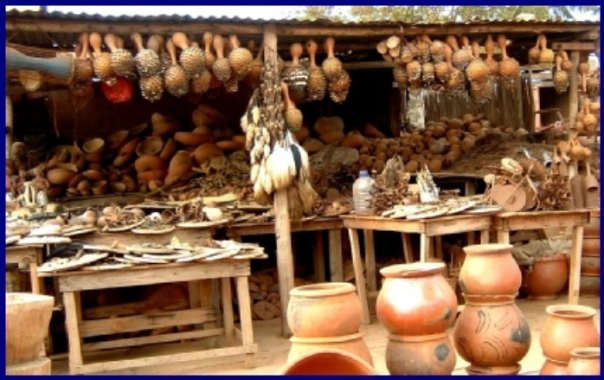
Traditional ritual ‘fetish’ market in Togo. The practice of folk magic known as Hudu or “Hoodoo” by the enslaved Africans in the Diaspora is as old as Africa herself.

About.com Tammy Todd:

What exactly is Hoodoo?


Mama Zogbé:

Briefly, "Hoodoo" is an Afro-derived mystical system of personal and psychological
empowerment, via the specialized use of roots, herbs & minerals in a beneficent or
maleficent manner to obtain a desired result, e.g., protection, healing, wealth, justice,
victory over enemies, etc.,. Its extensive body of esoteric knowledge, ethos, native
customs, and universal folk beliefs, are traditionally passed down [usually in families]
from generation to generation.

Tammy Todd:

Is Hoodoo a type of magic?

Mama Zogbé:

No. Not how the term "magic" is defined and perceived in Western culture. However, "Hoodoo" is
indeed an African mystical tradition, known by various names, that is practiced all over Africa,
and has been for thousands of years. It is perhaps the first tangible application of the
supernatural, based upon the Africans intimate relationship with the phenomena of Spirits who
taught and assisted them in surviving the powerfully rich, but yet untamed environment in which
they found themselves.
For example, in the West African & Diaspora Mami Wata Vodoun tradition, the forest spirits,
known as "Azzizas," were the most evolved guardians of the forest, who first presented
themselves to the African hunters, and planters. They taught them the esoteric, medicinal
(ahame) use and alchemical properties inherent in the abundance of herbs, trees, roots, minerals
and life forms thriving in their mists.
It was the Azzizas who also taught the African how to make poisons, potions, medicines, and
Gbo, "ebo"" and "boicho/bo."( known today as "mojo, amulets, talisman, ouangas"). Joined with the
Azzizas, was the divinity later to be identified as "Legba," the great messenger of the gods, who
also taught the Africans the use of Gbo and transported their prepared requests to the respective
divinities.
The first practical and most extensive use of herbs, amulets and talismans in the forest was for
protection from accidents & tropical disease, dangerous animals, repairing injuries, as well as to
assure success in their hunt. However, their esoteric use was mainly for protection from
jealously, envy, and death by other hunters, as well as protection from the angry spirits of those
animals which were killed for food, or by accident during the course of the hunt. From these
primary ancestors, eventually evolved a group of specialized priests and priestess known in
Dahomey as Bokonons, (geomancers), Azondoto, Zokas, Garbara, Akpases (sorcerers), and
Botonons.
It was this knowledge that the Africans brought to the New World with them, and later
incorporated and adapted with the indigenous Indian, and some European folklore, which came to
be known as "Hoodoo". This is just from Dahomey. The above does not even cover the Congo
traditions which are also heavily incorporated into the Hoodoo tradition here in America.
Herskovits, in his book "Dahomean Narrative: A Cross-Cultural Analysis; Melville J Herskovits &
Frances S. Herskovits. 1998, Northwestern University Press." offers-up a rich body of folk-lore,
and regional beliefs of the Hunter Stories and their relationship with these forest spirits in
Dahomean culture.
Tammy Todd:

How does Hoodoo relate to the traditional beliefs of Africa?

Mama Zogbé:

In West Africa, the Azzizas & Legba are the guardian spirits who first taught this art
and its accompanying laws to the first family of Africans. The use of "Gbo"
(talismans, amulets), for both offensive and protective "magic" was widespread and
taken as a rite of survival in Dahomean culture. It was Legba who taught this art to
the first consecrated body of priest/ess in African mystical and religious practice.
Extensive knowledge of herbs, minerals, roots, and their specialized use in healing,
initiations, ritual ceremony, "folk-magic" and medicine, is integral to our
professional development and competency as priests.

Tammy Todd:

How does Hoodoo relate to the traditional beliefs of Africa?

Mama Zogbé:

In West Africa, the Azzizas & Legba are the guardian spirits who first taught this art
and its accompanying laws to the first family of Africans. The use of "Gbo"
(talismans, amulets), for both offensive and protective "magic" was widespread and
taken as a rite of survival in Dahomean culture. It was Legba who taught this art to
the first consecrated body of priest/ess in African mystical and religious practice.
Extensive knowledge of herbs, minerals, roots, and their specialized use in healing,
initiations, ritual ceremony, "folk-magic" and medicine, is integral to our
professional development and competency as priests.

Tammy Todd:

Would Hoodoo still be recognizable to a member of
an African Traditional religion?

Mama Zogbé:

Absolutely. Of course, with some cultural variations, and with more emphasis on
conjuration and medicine. "Hoodoo" was passed down from our oldest Ancestors
[through direct family lineages], and it is they who still today possess the most
extensive esoteric knowledge, which distinguishes them from the general "folk"
practitioners [especially in the U.S.] who learn their art primarily from books, and its benefits are largely contingent upon their own level of "asé" (spirit development).

Tammy Todd:

How is Hoodoo viewed in the modern
African American community?

Mama Zogbé:

In America, there was [and still is] pervasive discrimination and bias against all African
religions and ritual practices, which were greatly feared by the Europeans. This was so
because "conjuration" (a more potent form of this system) was heavily emphasized and
used as a passive-aggressive weapon against slavery and the brutality of many
enslavers against our African foremothers and fathers. Laws were enacted to stop all
forms of Afro-religious practices, via an often violent campaign to discredit its
priesthoods and debase its holistic practices. The "jungle bone-in-nose-witch doctor"
and the "jive-talking-miss-Cleo-sorceress" are the most infamous of these belittling
images.
Nonetheless, many southern, African-Americans, and those who migrated from the
rural south to the urban cities continued to practice their folk traditions, and many either
hid, or did away with them completely. Ironically, today, many aspects of Hoodoo is now
being packaged as "Wicca, New Age" and "Alternative Medicine and Healing," with no
credit given to its indigenous African roots.

Tammy Todd:

Do you think that the removal of the spiritual aspect of Hoodoo
has degraded the practice? Is it still in harmony with the Gods?

Mama Zogbé:

It is not the nature of Hoodoo that is "out of harmony with God," but rather the nature of the
inherent weaknesses in the human character, which has caused its maleficent practices to
manifest in the first place.
The majority of what is now called "Hoodoo" was practiced in Africa largely for defensive
purposes. That is to say, it was universally commissioned to protect one from the "evil eye",
(jealously, envy) revenge, and the hatred of others, and from sorcerers. Outside of my normal
functions, a significant part of my work is removing what many believe is "Hoodoo" having been
done to them from other people.
Conversely, Hoodoo, though a part of the ritual practices in ATRs was never viewed as a "spiritual
tradition." What caused the rift in which Vodoun practitioners looked down upon the "Hoodooist,"
was due to the ignorance of the public in not being able to differentiate between the two
traditions. This ignorance resulted in all ATRS being lumped into the same category as "Hoodoo."
This worked to the advantage of many Hoodooists, who began to pass themselves off as "Voodoo
priest." This would be equivalent to a chiropractor passing herself off as an orthopedic surgeon. It
was this professional and moral intrusion that angered many ATR practitioners. Unfortunately,
what passes for African cosmology/religion today is viewed as "Hoodoo" and the majority of what
passes for "Voodoo" by Hollywood, and popular culture actually is African folk magic, or "Hoodoo."
Many so-called famous "Voodoo" priest/ess are actually "Hoodooist," but this distinction is
obvious to us and others who understand our traditions. This ignorance especially worked well
for Christian evangelicals, laced with Eurocentic racism, who would make us think that the
African spiritual intellect never rose above "maleficent magic and superstition."

Tammy Todd:

You make a distinction between traditional healing (rootwork) and conjuring. How can
someone recognize rootwork from conjuring?

Mama Zogbé:

Rootwork, (rootman/woman) is merely someone who uses roots primarily in
procuring medicines, poultices, and other healing applications for physical as
oppose to spiritual illnesses. Conjuration, on the other hand, is something entirely
different. Conjuration is closer to how Hoodoo is practiced in Africa, and requires
a more specialized knowledge and power that cannot be discussed in this forum.

Tammy Todd:

Many people associate conjuring with black or
evil magic. How does Hoodoo relate to evil?


Mama Zogbé:

Since the beginning of time, Africans have always believed in a
high god, and through the agency of their Ancestors, and their
divinities, have always incorporated moral teachings in its social
and philosophical structure. However, African philosophy and
theology does not view "evil" as extreme and as definitive as the
Westerner. In Africa "evil" is a relative term, and relates mostly to
how an act or action affects an individual, their family, village and
nation. It is not the *means*, but rather the *results* and its
aftermath that determines what is "evil."


Tammy Todd:

One of the most visible forms of Hoodoo for white America are the
products marketed to the African American community, such as
the various oils and incenses found in some areas. Do you think
that these products are a part of the Hoodoo tradition?

Mama Zogbé:

As stated above, the African in their new environment utilized whatever natural resources to
both shield their traditions (which were constantly under attack), as well as to incorporate
their traditional mystical practices into their new life in North America. This they did by
obtaining from a variety of sources not indigenous to Africa (i.e., Native American, and
European). Again, these were merely local adaptations incorporated into an already fully
developed and powerful, esoteric African system. They knew what roots and herbs would best
serve as substitutes, and utilized them. The popular myth that they were taught these
practices by Whites, and Native Americans is not supported by neither history nor the
research. In fact, history reveals that it was African ritual and botanical practices which
heavily influenced the latter.

Placeholder Picture

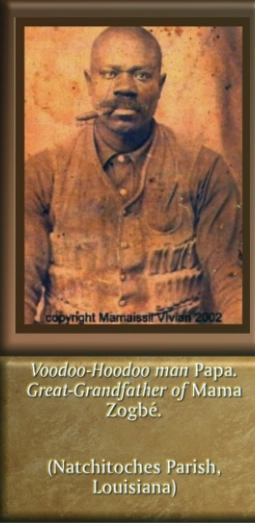
For example, I have a photo of my own great-grandfather on my Hoodoo page, in which he is
wearing a modified bakakari jacket. A jacket laced with amulets (multi-pockets) for protection
against sorcery. Here his jacket is a Western styled design, but modified for an entirely
different purpose. He did not need the Western style jacket, but the traditional animal skin that
is used was not available. Merely, one example of their ingenious ability to adapt to their
environment.
This same concept applies when one carefully examines the popular New Age myth that
Diaspora Vodou was created by syncretizing with Christianity. That is to say, that it somehow
needed elements of Christianity in order to be complete. In truth, the Vodoun religion used
Christianity as it is known in the West, as a protective shield against the on-going persecution
the Africans were experiencing. They did so in order to practice and preserve the religion from
cultural destruction. One can remove all traces of Christianity from the Vodou and still have a
whole fully functioning tradition as it has been for thousands of years. It simply isn't needed to
meet any of the cultural, theological and ritual objections of the Vodou deities nor of the
ancestors.

Tammy Todd:

If you could send one message about the practice of
Hoodoo to the general public what would it be?

Mama Zogbé:

I consider Hoodoo, like Jazz, and the Blues to be an Afro-American spiritual art, and gift to
the New World. It is laced with many hidden mysteries, which reflect the epitome of what
our Ancestors endured and survived during Slavery, Reconstruction, Jim Crow and
presently. It is a precious gift to the world, and those who choose to take the time to study,
and learn its truths, and honor (as opposed to merely profit from) our ancestors, who
sacrificed greatly to bring this sacred knowledge to us, will be immensely rewarded by it. I
hope to someday see African Spiritual practice honored, and properly credited to its African
sources, and taught in school the same way all other traditions are.

mwhs logo


The Mami Wata Healers Society Temple of Mawu.  © All Rights Reserved. Some Rights Reserved to the Respective Authors. Replication, Duplication and Infringement are Prohibited.


Tel: +1 706 814 2054
PRESERVED AND PRESIDED BY 
CHIEF HOUNON AMENGANSIE AWONO MAMA ZODÉDÉ.
OFFICIAL EMAIL
MAMATHEFIRE50@YAHOO.COM