
Translate this page:
You can translate the content of this page by selecting a language in the select box.
Share this link!
West African traditions are rich in folklore, proverbs and wisdom. Contrary to Western stereotypes, Africans uprooted and enslaved in the Americas brought with them a repository of tried and tested spiritual, social, and philosophical knowledge passed down to them by their ancestors for thousands of years. Below is a sampling of some of the customs and oral folkloric traditions that were in place during the time colonialism and slavery began to take root in West Africa. Most of the sayings are very much as relevant today as they were then.
1. Stone in the water-hole does not feel the cold. (Answers to our "Habit is second nature.")
2. He who has to carry does not walk bent.
3. The hunchback does not sleep on his back.
4. He whose hand can meet no chair, sits on the ground.
5. If the short mat is not in a man's hand, he sleeps standing. (These are used to mean, "Accommodate yourself to circumstances.")
6. A poor man can never become a priest.
7. Nobody sits by a fire and cries. (This refers to the smoke from a wood fire getting into the eyes and giving the appearance of tears. It is used in the sense of "Do not judge by appearances.")
8. Two eyes one has, but two things one does not see.
9. Two ears you have, but two things you do not hear.
10. Two arms you have, but two kinds of work you do not do at once.
11. No one chases two birds. (These mean, "You cannot do two things at once.")
12. Two men are not blockheads. (Answers to, "Two heads are better than one.")
13. One man cannot serve two masters.
14. A child and water are not together.
15. Poor and rich do not go together.
16. Water and fire are not together.
17. If a pregnant woman falls, the child in the womb answers. (Means that nothing can be so carefully concealed that it will not be discovered, and is equivalent to "Murder will out.")
18. Whoever goes abroad does not hear family news.
19. As the child has not seen what happened before his birth, let him be satisfied with having it told him.
20. The stick you have in your hand is that with which you strike the snake. (This means, Make the most of your opportunities.)
21. Two kings do not rule in one town.
22. A barking dog does not lie in the hyena's lair.
23. The goat does not pass the leopard's door.
24. If the mouse be ever so drunk, he does not go to sheen in the cat's bed.
25. Clothes are men. (Equivalent to "The tailor makes the man.")
26. If the cloth be greasy, it is not burnt. (Means, "Things might be worse.")
27. Riches buy slaves, but not life.
28. If the boy says he wants to tie water with a string, ask him if he means the water in the pot or in the lagoon. (Means, "Answer a fool according to his folly.")
29. No child of man knows the day of his death.
30. The fowl in the coop does not know the day of his death. (These refer to the uncertainty of life, but the second is used to remind slaves that they are liable to be sold at any time.)
31. A poor man's son does not brag.
32. Cowries are men. (Equivalent to, "Money makes the man.")
33. The dog does not look in the room and say, "Is that your father's property, or your mother's?"
34. Have you ever buried a hunchback, and gone home? (These two are used to inquisitive persons, and the second means that they might be curious to know in what position a hunchback would be laid in the grave.)
35. The guest does not surpass the host.
36. If water falls on a stone it does not trickle through it.
37. Fire devours the grass, but not the roots.
38. When the leopard sleeps you might think him dead.
39. The shepherd's staff does not kill the sheep.
40. The lash that drives the herd does not kill them.
41. The plantation owner takes away the wood, but not the rope. (The cut brushwood belongs to the man who clears the ground, and this proverb supposes the case of such a person finding some of the wood tied up in a bundle by somebody else, ready for removal. It is used in the sense of, "Take only what is your own," and also in that of, "Do not act in hot haste.")
42. The death of the suicide cannot be avenged.
43. A crab cannot become a bird. (Equivalent to, "You cannot make a silk purse out of a sow's ear.")
44. The elephant's tail is short, but with it, he drives off the flies.
45. A cask of rum cannot roll itself.
46. A large shell (of the cowry species) cannot buy goods to the value of even two cowries. (The large cowry shells are not circulated as money. Equivalent to "Little and good.")
47. Nobody takes a trinket and hangs it round the neck of a wild bird.
48. What hangs in the hand goes not to the well. (Baskets with handles are carried in the hand, while other articles, such as water-pots, are carried on the head. The proverb means, "No one fetches water in a basket.")
49. Nobody unroofs the house in the town to roof the house in the plantation. (The town house is the ordinary abode, that is)
Source: A.B. ELLIS: THE EWE-SPEAKING PEOPLES OF THE SLAVE COAST OF WEST AFRICA THE RELIGION, MANNERS, CUSTOMS, LA W.S., LANGUAGES,BENIN PRESS, Ltd. CHICAGO 1965
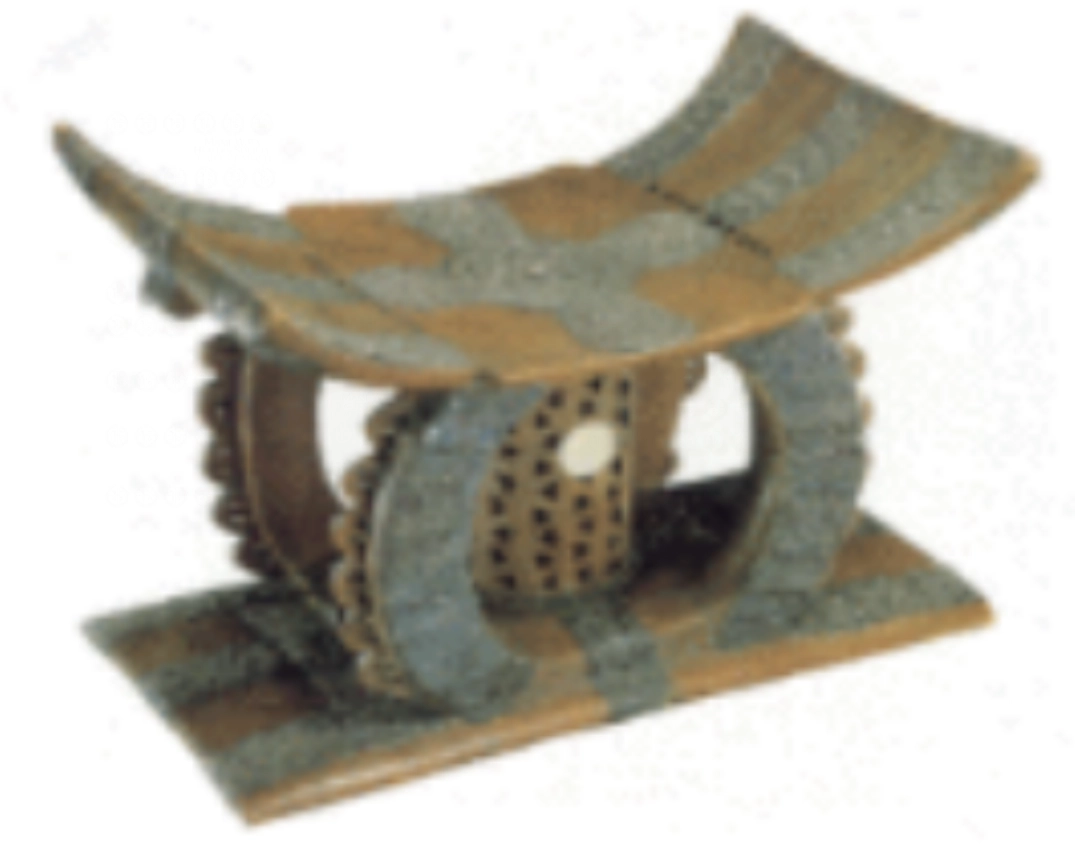
Stool: Royal Stool of both Ashanti and Ewe tradition: Myths of the world: Legends of Africa. Metro Books, N.Y., 1996. pg.66.