Translate this page:
You can translate the content of this page by selecting a language in the select box.
Share this link!

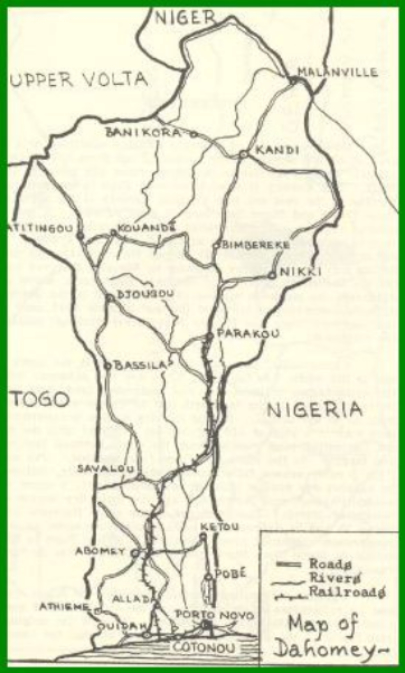
The precolonial history of the south is closely tied to the rise of the Fon kingdom of Dahomey (actually Danhomë), with its center in Abomey. The dynasty expanded to the south and west, eventually (1724) conquering Allada (known to European traders as Ardra) which according to legends was the parent-state of both the Dahomey and later the Porto Novo kingdoms.
In 1727 the key port of Ouidah (Whydah) was conquered, giving Dahomey direct access to the gun market through European slave traders who were established all along the coast. The destruction of Allada power ushered in a long era of invasions from the Oyo Empire (to which Allada had been a tributary state) and the subjugation of Dahomey to nominal Oyo suzerainty.
In 1818, Oyo domination was thrown off in the wake of a major resurgence of Dahomean power and expansion under two of the kingdom's most illustrious kings, Ghézo and Glele. At the height of its power, Dahomey became widely known in European capitals, gaining further fame for its elite women's military units (The Amazons).[1]
Unfortunately, it was under the aegis of King Glele that slavery increased, and was the chief major export to European and American slavers, as well as the major source of wealth and economic prosperity of the region. It was from the profits from the sale of African war captives as slaves that enabled Dahomey to regain its military dominance in the region, and finally shed the shackles of the Oyo State.
Today, the population of Dahomey estimates around 8-10 million. The major groups being the Adja (who later changed their name to Ewe), the Fon (a major subgroup of the Ewe, both groups concentrated in the southern regions. The Yoruba, who maintained major trade and slave ports in the east, and the Bariba (today known as the Tchamba, Somba, Batammaliba, Tata Brema among other names) of the north.
Of the above groups, it is the Tchamba who are the actual aboriginals of the region. The Adja and Fon, both being some of the original descendants of the Oyo State in Nigeria, immigrated to these regions as early as the 11th Century. During the mid-1800s, the invasion by the Fulani in the north resulted in the final destruction of the Oyo State. Many of the Tchamba were converted to Islam under compulsion and sold to American and European merchants as slaves. It is also from these groups that the majority of the slaves were taken and brought to America and the surrounding coastal islands.
African Tradition and Culture: Media